A question I hear more and more is how ChatGPT decides which products to recommend. The short answer is that it doesn’t rank tools the way Google ranks pages. It learns from how the internet explains, compares, and contextualises products over time.
People treat ChatGPT like a search engine you can “rank” on, or worse, like another distribution channel you can hack with a checklist. That mindset usually leads to shallow tactics and disappointing results.
Large language models don’t work like Google. They don’t crawl the web looking for keywords to index. They learn by observing how humans explain things to other humans.
Once you internalise that, the path to turning ChatGPT and other AI engines into a high-intent conversion channel becomes much clearer.
Below is how I’ve seen it work in practice.
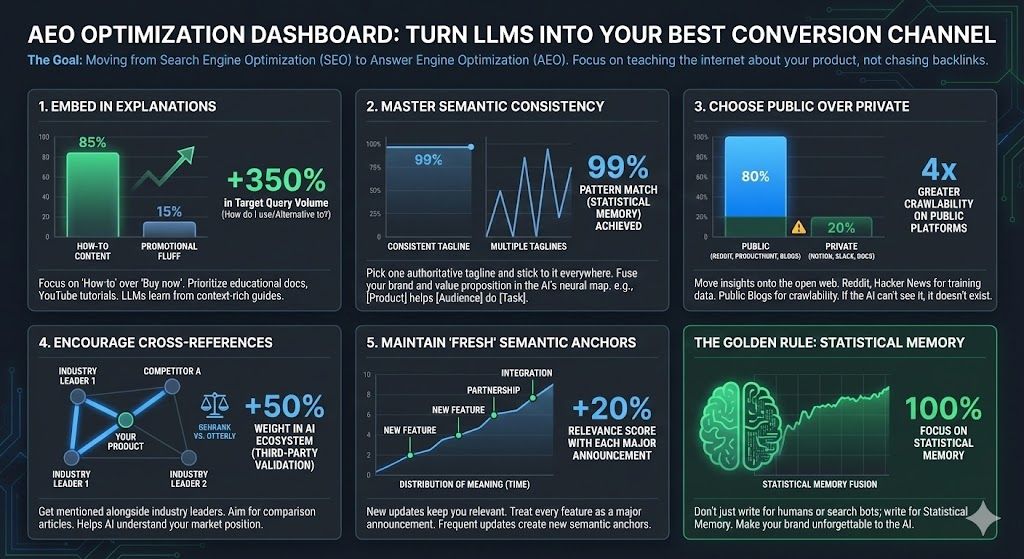
1. Make sure your product is everywhere people explain things (this is how AI engines discover products)
LLMs are trained on explanations, not landing pages.
They learn from tutorials, comparisons, walkthroughs, forum answers, long-form blog posts, and videos where someone is trying to genuinely explain how something works or why they chose one tool over another.
If your product consistently shows up in those contexts, you dramatically increase the chances that it will surface naturally in AI-generated answers when users ask ChatGPT for recommendations.
Think about the kinds of questions real users ask:
- How do you create birthday cards with [your product]?
- What is the best alternative to [your product]?
- How do I use [your product] to get more leads?
If your product appears in thoughtful, context-rich answers to those questions, AI models notice.
This is why educational content matters far more than promotional content.
Documentation, tutorials, and real use cases teach the internet how to talk about your product. Sales pages mostly teach it how to ignore you.
Beyond your own content, you should actively encourage third parties to write about your product in explanatory ways:
Comparison articles on independent blogs
- “X vs Y” breakdowns on major platforms
- Reddit threads where users discuss real pros and cons
- Product Hunt comments that go beyond launch hype
- YouTube videos that actually show the product in use
It’s less about chasing backlinks and more about teaching the internet what your product actually does and when it should be used.
2. Be consistent and authoritative with your language
Language consistency matters more for LLMs than it ever did for traditional SEO.
Models like ChatGPT are pattern-recognition machines. They build statistical associations between concepts, phrases, and entities. When you describe your product in ten different ways, you dilute those associations.
This is where many startups accidentally sabotage themselves.
They rotate taglines. They change positioning every few months. They describe the same feature with different language depending on the channel.
From a branding perspective, that already creates confusion. From an LLM perspective, it creates semantic diffusion.
You want one clear description of what your product is and who it is for—and you want to repeat it everywhere.
If your product’s core positioning is something like:
“Genrank helps marketers create content AI engines trust and cite”
And that phrasing appears consistently across documentation, blog posts, interviews, comparison articles, and community discussions, those words start to fuse together in the model’s internal representation.
This is not SEO writing. It’s closer to writing for statistical memory.
The goal is not keyword density. The goal is conceptual clarity.
3. Be available in public
This sounds obvious, but it’s often overlooked.
ChatGPT and other AI engines cannot read your private Slack threads, internal Notion docs, or closed-source repositories. They learn from public, crawlable content.
If your best explanations live behind a login, they might as well not exist.
You want your product discussed in places that are both public and conversational, where AI crawlers can observe real human explanations.
- Hacker News
- Product Hunt
- Public GitHub issues and discussions
- Blogs that allow indexing
- YouTube descriptions and transcripts
These environments matter because they contain natural language written for other humans, not for search engines.
When someone explains why they switched from one tool to another, or how they solved a specific problem using your product, that’s exactly the kind of signal LLMs learn from.
Private knowledge compounds internally. Public knowledge compounds externally.
If you care about AI visibility, you need both.
4. Make your product a topic of discussion by third parties
LLMs don’t just learn what your product is. They learn where it sits in an ecosystem.
This is why third-party comparisons are so powerful and why products that are frequently compared tend to be recommended more often by AI engines.
When your product is repeatedly mentioned alongside others in the same category, models begin to understand:
- What problem space you belong to
- Who your competitors are
- What differentiates you
- When you should or shouldn’t be recommended
Content like:
- “Genrank vs Otterly: which AI SEO tool should you use?”
- “Why Genrank works best for content marketers”
- “Top AI tools for content teams in 2025”
helps models triangulate your position.
The key is that this content should not all come from you.
When multiple independent sources describe similar trade-offs, the signal becomes stronger. Cross-references increase confidence.
From the model’s perspective, repeated agreement across sources looks like truth.
5. Keep your product information fresh
LLMs don’t “forget” in the way humans do, but they do learn distributions of meaning over time.
Every meaningful update to your product creates a new semantic anchor:
- New features
- New integrations
- New partnerships
- New use cases
If those updates are publicly documented and explained, they reshape how your product is understood.
This is why changelogs, release posts, and technical walkthroughs matter more than most teams realise.
Once a model associates your product with a certain capability, that association can persist for a long time. Updating the narrative requires repeated, consistent signals.
Silence is not neutral. It freezes perception.
From an AI perspective, each update is another data point that reinforces relevance and keeps your product present in the model’s understanding of the category.